For 20 years, the path to a hotel booking looked the same: a traveler typed "hotels near downtown Atlanta" into Google, scrolled past the ads and the OTAs, and maybe found your website.
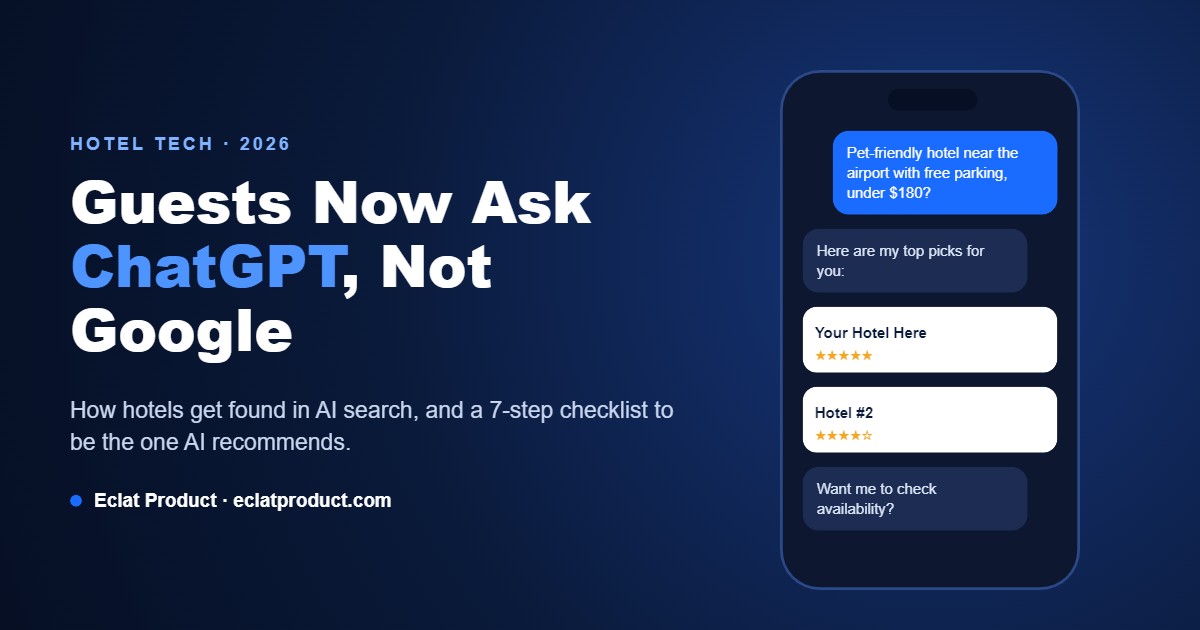
That path is changing fast. Today a growing number of travelers skip the search results entirely and ask an AI assistant: "Find me a quiet, pet-friendly hotel near the airport with free parking, under $180 a night." ChatGPT, Google's AI Overviews, Gemini or Perplexity then reply with two or three names, not ten blue links.
If your hotel isn't one of those names, you're not on page two. You're simply not in the conversation.
The numbers hoteliers can't ignore
- About 84% of US travelers say they're more likely to book a hotel based on a trusted AI recommendation, and more than 75% of AI trip-planning users have booked travel mainly because of one (TakeUp / Pollfish survey of 300 US leisure travelers, January 2026).
- 89% of consumers want to use AI in their travel planning (Booking.com research, cited by CoStar).
- 82% of hotel tech decision-makers expect their AI use to grow in the next year, and 85% plan to spend at least 5% of their IT budget on AI tools (Canary Technologies survey of 400+ hotel professionals, 2026).
The American Hotel & Lodging Association's David Sjolander summed it up to CoStar: the industry is "at a real pivot point on the distribution side," and hotels "can't just sit back and wait and see what happens."
How does an AI decide which hotel to recommend?
AI assistants don't have a secret hotel list. They build an answer from what they can find and trust across the web:
- Your website. Clear, readable text about your rooms, amenities, location and policies.
- Your Google Business Profile. Hours, photos, categories, Q&A and reviews.
- OTA and review sites. Booking.com, Expedia, Tripadvisor and Google reviews.
- Consistency. If your website says "free parking," your Expedia listing says "$15/night," and a review says "parking was a nightmare," the AI is less confident about you and more likely to recommend someone else.
AI rewards hotels that are clear, consistent and easy to understand. The good news: that's very fixable.
A 7-step checklist to get your hotel recommended by AI
1. Write for questions, not keywords
Travelers ask AI full questions: "Is there a shuttle?" "Can I bring my dog?" "How far is it to the stadium?" Add a plain-text FAQ page that answers the 20 questions your front desk hears most. If the answer lives only in a PDF or an image, the AI likely can't read it.
2. Spell out what makes you the right pick
"Comfortable rooms and great service" tells an AI nothing. "5-minute walk to the convention center, free EV charging, 24-hour gym, rooms with kitchenettes for extended stays" gives it specific reasons to recommend you for specific requests.
3. Add structured data (schema markup)
Schema is code on your website that labels facts for machines: hotel name, address, star rating, amenities, check-in time, FAQs. It's invisible to guests but tells search engines and AI exactly what you offer. Most hotel websites are missing it or have it broken.
4. Make your information match everywhere
Audit your website, Google Business Profile and every OTA listing on the same day. Same name, address, phone number, amenities, pet policy and parking details. Inconsistent data is one of the most common reasons a hotel gets passed over.
5. Treat reviews as AI fuel
AI assistants read reviews to judge what a hotel is actually like. Respond to reviews (good and bad), and when guests mention specifics like "spotless rooms" or "great for business travelers," those phrases help AI match you to the right searches.
6. Be ready when the AI sends someone your way
A guest who arrives from a ChatGPT recommendation usually has one or two last questions before booking. If nobody answers at 11 PM, they go back to the AI and pick the next hotel. A 24/7 AI chatbot on your website that answers questions instantly and guides guests to book direct closes that gap and saves OTA commission at the same time.
7. Measure your AI traffic
In Google Analytics 4, check your referral traffic for sources like chatgpt.com, perplexity.ai and gemini.google.com. It's often small today, but it's the fastest-growing channel, and you want a baseline before your competitors start paying attention.
Common mistakes to avoid
- Hiding key info in images, PDFs or booking-engine pop-ups where AI can't read it.
- Letting OTA listings go stale after you change amenities or policies.
- A slow, outdated website. If the page barely loads on a phone, neither guests nor AI will spend time on it.
- Waiting for "AI search" to settle down. The hotels that get cited early build the trust signals that keep them cited.
The bottom line
Search isn't disappearing. It's being summarized. In 2026, getting found means being the hotel an AI is confident recommending: clear information, consistent listings, strong reviews and a website that can answer guests instantly, any time of day.
Eclat Product helps hotels get ready for AI search, from website fixes and schema markup to AI chatbots built for hotels that answer guest questions 24/7 and drive direct bookings.
👉 Book a free 20-minute call and we'll show you how your hotel currently shows up in ChatGPT and Google AI, and what to fix first.
Sources: CoStar; Asian Hospitality (TakeUp survey); Hotel Management (Canary Technologies report).