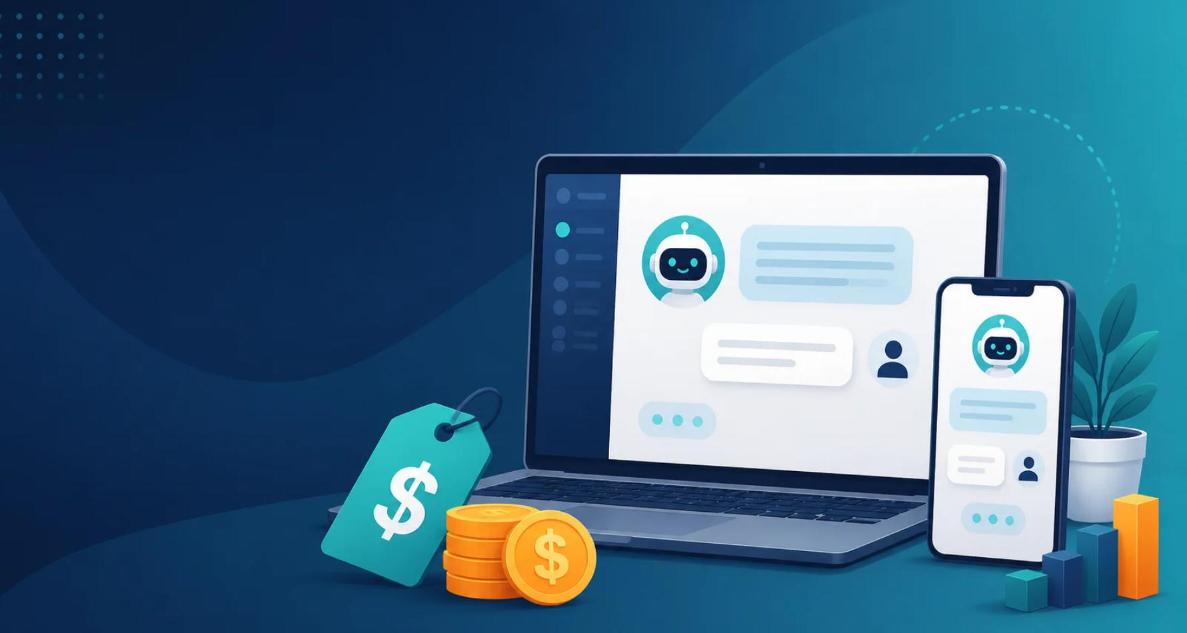
"How much does an AI chatbot cost?" is usually the first question we hear from small business owners, and the honest answer is: anywhere from about $20 a month to well over $50,000. That range is not helpful on its own, so this guide breaks down what you actually pay for, which option fits which kind of business, and how to avoid paying for more than you need.
The short answer: three ways to get a chatbot
Almost every AI chatbot falls into one of three buckets.
1. Off-the-shelf chatbot software (roughly $20–$500 per month)
Tools like Tidio, Intercom, Zendesk and similar platforms let you add a chat widget to your website and train it on your FAQ pages. According to a 2026 pricing roundup by Denser, small businesses typically pay about $19–$89 per month and mid-market companies $100–$500 per month. Many platforms also charge per AI-resolved conversation, often in the range of $0.50–$2.00 per resolution, which can add up quickly once traffic grows.
Best for: simple FAQ answers, opening hours, basic lead capture.
Watch out for: per-seat and per-resolution fees, limited control over how the bot talks, and little or no connection to your own systems.
2. A custom chatbot built on a modern AI model (roughly $10,000–$75,000 one-time)
A custom chatbot uses a large language model, but it is trained on your documents, connected to your tools (booking system, CRM, inventory, order status) and written in your brand voice. Industry estimates put a simple AI chatbot at around $10,000–$30,000, and a mid-complexity build with CRM integration and custom training at $30,000–$75,000. Each extra system integration typically adds $5,000–$25,000.
Best for: businesses where the bot needs to actually do things, such as book an appointment, check an order or qualify a lead and send it to sales.
3. Enterprise-grade AI assistants ($75,000 and up)
Large organizations with strict compliance rules, many departments and deep integrations can spend six figures. Most small and mid-size businesses do not need this tier.
What actually drives the price
- What the bot needs to do. Answering questions from your website is cheap. Booking, quoting, updating records or handing off to a human costs more because each action is an integration.
- Where it lives. A website widget is the starting point. Adding SMS, WhatsApp, Facebook Messenger or a phone line (an AI receptionist) adds channels to build and test.
- How much it talks. AI models are billed by usage. A well-built bot keeps those costs predictable with limits, caching and short, focused answers.
- Data and privacy. Bots that handle patient, payment or personal data need extra safeguards, and that design work is part of the price.
- Ongoing care. Plan for maintenance. A common rule of thumb is 15–20% of the build cost per year for updates, monitoring and improvements.
Which option is right for you?
Here is the quick decision guide we use with clients:
- Fewer than a few hundred chats a month and mostly FAQ questions? Start with an off-the-shelf tool. Do not overspend.
- Losing leads after hours, or staff answering the same questions all day? A focused custom bot that captures leads and books appointments usually pays for itself fastest.
- Paying for many seats or per-resolution fees on a SaaS tool? Compare a year of subscription costs against a one-time custom build. Past a certain volume, owning your chatbot is cheaper.
- Hotel, inn, restaurant or medical practice? Look for a bot that connects to your booking or reservation system. That is where most of the value is.
Real examples of where chatbots save time
- Hotels and inns: answering pre-arrival questions (parking, check-in time, pet policy), offering room upgrades and sending guests to the booking engine.
- Medical and dental clinics: after-hours appointment requests, insurance and location questions, and intake form links, with clinical questions always handed to staff.
- Service businesses: qualifying leads ("What's your budget? When do you need this?") and booking a call on the calendar automatically.
- E-commerce stores: order status, returns and product questions at any hour.
How to keep your chatbot budget under control
- Start with one job. Pick the single task that costs your team the most time and automate that first.
- Use your existing content. FAQs, policies and service pages are the cheapest training data you have.
- Set usage limits. Cap conversation length and monthly AI spend so there are no surprise bills.
- Always offer a human. A clear "talk to a person" option protects your reputation.
- Measure it. Track leads captured, bookings made and hours saved, not just chat volume.
Get a straight answer for your business
At Eclat Product, we build AI chatbots and automation for small and mid-size businesses in Georgia and across the US, with a focus on hospitality and independent medical practices. We will tell you honestly whether an off-the-shelf tool is enough or whether a custom build makes sense, and give you a clear estimate either way.
Book a free 20-minute consultation or learn more about our AI and custom software development services.
Sources: