If you've applied for tech jobs lately, you've probably felt it: hundreds of applicants per opening, interviews that go nowhere, and remote roles that vanish within days. You're not imagining it. But the full picture is more interesting than "there are no jobs."
The numbers behind the feeling
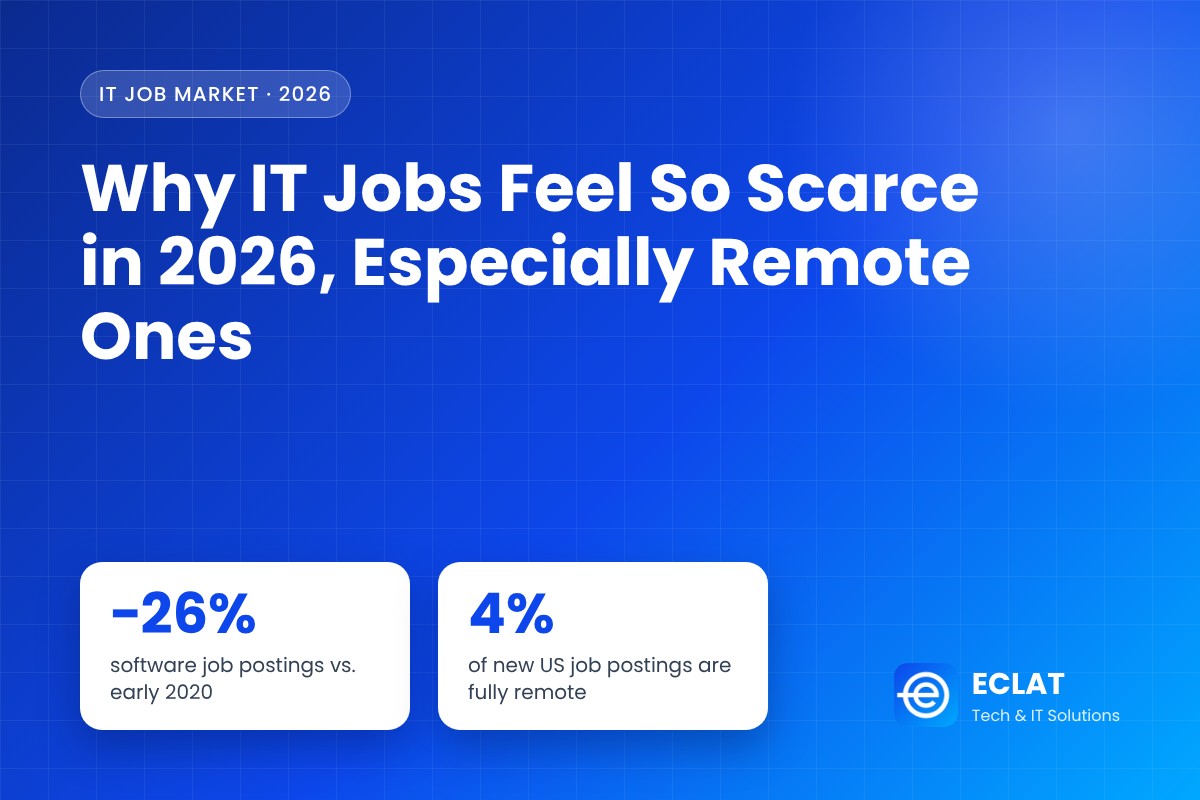
According to Indeed Hiring Lab data from August 2026, software development job postings sit about 26% below their February 2020 level, even though job postings across all US industries are now slightly above that baseline. Software postings hit their low in May 2025, almost 39% below pre-pandemic levels, and have climbed back since, but slowly.
The recovery isn't even, either. Most of the rebound has come from senior roles and jobs that ask for AI skills. Junior and entry-level developer openings are still far below where they were in 2022.
Remote work is where the squeeze hurts most. Robert Half found that only about 4% of new US job postings in early 2026 were fully remote. At the same time, Gallup's tracking shows that nearly half of remote-capable tech employees still work fully from home. In other words, plenty of people keep the remote jobs they already have, but very few new ones are being posted, and each one draws applicants from across the country (and often the world).
Why it happened
- The hiring hangover. Many tech companies hired aggressively in 2021 and 2022 when money was cheap. When interest rates rose, they cut back, and the layoffs and hiring freezes that followed are still working through the system.
- AI changed what teams need. AI coding tools let experienced developers do more, so companies are hiring fewer people for routine work and more for senior, architecture and AI-specific roles. That's why junior roles have been hit hardest.
- Return-to-office policies. Many large employers now want people in the office at least part of the week, so new roles are posted as hybrid or on-site, even when the work could be done anywhere.
- More competition per remote opening. A remote job in Atlanta competes with applicants in every state. A posting that once drew 50 local applicants can now draw 1,000.
It's not all bad news
CompTIA's State of the Tech Workforce 2026 report forecasts net US tech employment to grow about 1.9% this year (roughly 185,000 jobs) after a small decline in 2025, and it counted more than 275,000 active job postings in January 2026 asking for some level of AI skill. Demand hasn't disappeared; it has moved toward specific skills.
What this means for job seekers
- Learn to work with AI, not around it. Postings that mention AI skills are growing faster than the rest.
- Go deep in a niche. Microsoft stacks (.NET, Azure, Power BI), cloud, security and industry-specific software (hospitality, healthcare front-office, logistics) are easier to stand out in than "general developer."
- Consider contract work. Contract and C2C roles are often how companies test new projects before committing to full-time hires.
- Look local. Hybrid roles near you have far fewer applicants than nationwide remote ones.
What this means for business owners
For small and mid-size businesses, this market is actually an opportunity. Experienced developers are available, and you don't need to hire a full-time team to get a custom app, an AI chatbot or a better website built. A focused project with a contract team gets the work done without the cost and risk of a permanent hire.
At Eclat Product, we build custom software, AI chatbots, mobile apps and websites for businesses in Georgia and across the US, and we provide contract (C2C) developers for teams that need extra hands. If you have a project in mind, book a free 20-minute consultation.
Sources:
- Indeed Hiring Lab, US Labor Market Snapshot, August 2026, as reported by BlueLine Research
- Robert Half Q1 2026 job posting analysis and Gallup remote-work tracking, as reported by Talent Observer
- CompTIA, State of the Tech Workforce 2026